Introduction
When a vision-language model reasons about an image, its response contains two kinds of tokens. Some tokens carry information read from the image, such as “the base is cm”. The paper calls these perception tokens. Others carry reasoning that needs no image at all, such as solving , or recalling that the angles of a triangle add up to . These are reasoning tokens. Reinforcement learning with a reward for the correct final answer, such as GRPO [1], does not tell the two apart. A wrong answer is penalized in the same way whether the model misread the image or made a mistake in the algebra.
Earlier methods tried to give perception its own learning signal. Some make the model write its perception and its reasoning in separate tagged sections, and score the perception section with another language model, which breaks the natural flow of reasoning and invites reward hacking. PAPO [2] avoids extra models: it maximizes the KL divergence between the model’s predictions with the real and a masked image. But that KL divergence has no upper limit, which makes training prone to collapse, and PAPO applies it to every token of every response, including reasoning tokens and responses that got the answer wrong.
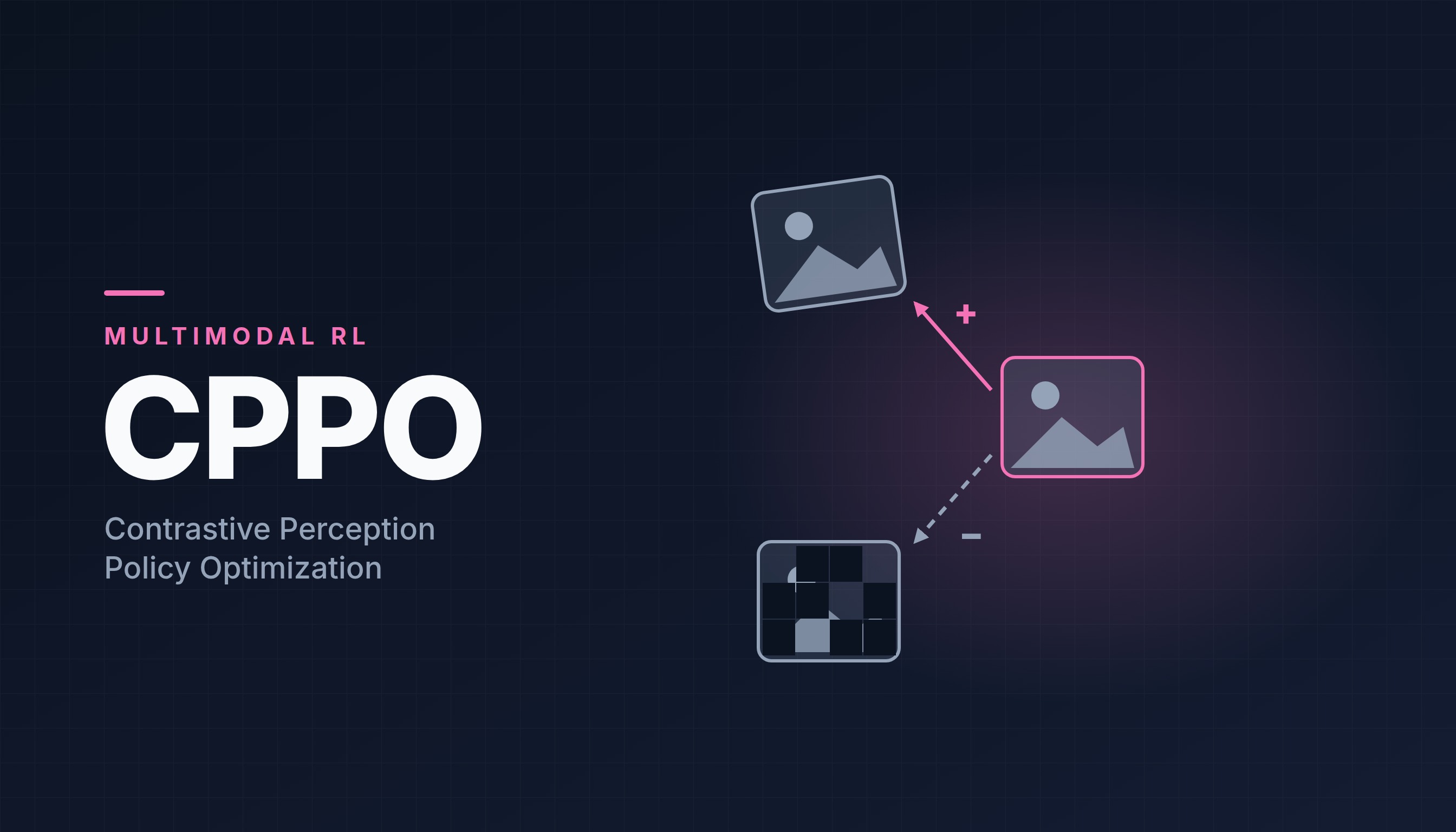
In 2026, a team from Huawei proposed CPPO (Contrastive Perception Policy Optimization) [3], which addresses both problems. It finds the perception tokens from the model’s own predictions, by checking which tokens become most uncertain when the image is hidden. On those tokens, and only in responses that did better than the rest of their group, it adds a contrastive loss: the prediction should stay the same when the image is changed in a harmless way, and change when the image’s content is removed.
In this post, we first recall the GRPO objective, then build the Contrastive Perception Loss, show how CPPO detects perception tokens and why the entropy test works, and put everything together in the CPPO objective, ending with the limitations.
The Starting Point: GRPO
The input is a query and an image . The old policy samples a group of responses , and each response , with tokens , gets a reward for its correctness. As in Eq. (3) of the GRPO post, the advantage of a response is its reward normalized within the group:
and the policy is trained with the clipped objective and a KL penalty toward a reference model, as in Eq. (7) of the GRPO post:
where is the probability ratio between the current and the old policy for token . The reward says only whether the final answer was right, so nothing in this objective gives the model a direct signal about its perception.
The Contrastive Perception Loss
CPPO’s perception signal compares the model’s prediction for a token under three versions of the image. The first is the original image . The second is an information-preserving perturbation , a change that keeps everything the question needs, such as slight color jitter, mild Gaussian noise, a small rotation, or a small change of perspective. The third is an information-removing perturbation , which hides what the question needs: of the image’s patches masked, or a crop that keeps only of the image. At each training step, one perturbation of each kind is picked at random [3].
For a token of a response, the model gives a distribution over the next token under each of the three images. In the language of contrastive learning, the distribution under the original image is the anchor:
the distribution under the information-preserving image is the positive sample:
and the distribution under the information-removing image is the negative sample:
The goal is a model whose perception is stable and sensitive at the same time. A harmless change to the image should not change what the model reads from it, so the anchor should be close to the positive. Removing the image’s content should change it, so the anchor should be far from the negative.
To measure closeness, CPPO uses the negative KL divergence as a similarity, , which is when the two distributions are identical and becomes more negative as they move apart. The similarities of the anchor to the positive and to the negative are:
These two similarities go into the InfoNCE loss [4], the standard loss of contrastive learning, with a temperature [3]:
The fraction is a softmax over the two candidates, the positive and the negative, so the loss is a cross-entropy that asks the anchor to pick out the positive as the more similar one. Dividing the numerator and the denominator by shows more clearly what it does:
and substituting the two similarities, :
The loss goes down when the KL divergence to the positive gets smaller, and when the KL divergence to the negative gets larger. This is where CPPO differs from PAPO. PAPO maximizes the KL divergence to the masked image directly, and the objective can grow without limit. Here, once the negative is clearly farther than the positive, the exponent becomes very negative, the loss approaches its minimum of , and its gradient fades. Pushing the negative even farther brings no further reward, so the model has nothing to gain from making its masked-image predictions arbitrarily bad.
Finding the Perception Tokens
The contrastive loss only makes sense for perception tokens. A reasoning token, such as a step of algebra, should not change much when the image is hidden, and pushing it away from the masked prediction would over-regularize the model and destabilize training. So CPPO first finds the tokens that the model itself treats as perception tokens, using the entropy of its predictions. The entropy of the prediction at step measures how uncertain the model is about the next token:
where is the vocabulary. CPPO compares this with the entropy under the information-removing image, and takes the difference [3]:
If a token was read from the image, hiding the image should make the model unsure what to write there, so its entropy rises. A reasoning token can be predicted from the text alone, so its entropy barely changes.
Why the Entropy Shift Works
The paper backs this up with mutual information [3]. The mutual information between the next token and the image, , measures how much knowing the image reduces the uncertainty about the token. It is connected to entropy by a standard identity: the uncertainty about the token given the image equals the uncertainty without it, minus what the image tells us:
The same identity holds with in place of . Writing both and subtracting, the term , which does not involve the image, cancels:
So the entropy shift is exactly how much more the original image tells us about the token than the information-removing one does. For a perception token, the paper assumes that the original image carries more information about it than the image with its content removed, so that the difference of mutual informations is non-negative, and therefore . The larger is, the more the token depends on the content of the image.
Selecting the Top Tokens
CPPO ranks the tokens of each response by the entropy shift of Eq. (4) and keeps the top fraction of them as perception tokens:
A binary mask marks the selected tokens:
The contrastive loss of Eq. (3) is applied only where the mask of Eq. (5) is , and the loss of a whole response averages over its tokens [3]:
The fraction trades coverage against focus. In the paper’s ablation, accuracy rose as grew from to and fell beyond that, because a larger starts to include tokens whose entropy barely changes, on which the model is already confident with or without the image [3].
The CPPO Objective
One more decision remains: which responses should get the contrastive loss. Training the anchor to stay close to the positive reinforces whatever the model read from the image. If the response was wrong, that perception may well be wrong too, and reinforcing it would make things worse. So CPPO applies the loss only to responses with a positive advantage from Eq. (1), the ones that did better than the average of their group. This is the advantage gating [3]:
In Eq. (7), the per-response loss comes from Eq. (6). The indicator is for responses above the group average and otherwise, and sets the strength of the contrastive loss, with working best in the paper. The GRPO part of Eq. (2) is unchanged, and the contrastive loss is subtracted, since the objective is maximized and the loss should be minimized.
Putting the pieces next to its predecessors shows what CPPO changes. PAPO maximizes an unbounded KL divergence on every token of every response. VPPO [5] also selects the most image-dependent tokens, but it uses them only to filter the GRPO gradient and adds no perception loss. CPPO adds a perception loss, but a bounded one, only on perception tokens, and only in responses that did well, and it adds a positive view, so the model also learns what should not change its perception.
Limitations of CPPO
CPPO needs two extra forward passes per response, one with each perturbed image, which made training about slower than GRPO in the paper. The perturbations are chosen by hand, and whether a change preserves the information depends on the question: a small rotation is harmless for reading a number off a chart, but not for a question about which line is horizontal. The entropy test rests on the assumption that the original image carries more information about a perception token than the perturbed one, and it is only as good as the information-removing perturbation. The experiments use Qwen2.5-VL models of up to billion parameters and about training examples. And despite the paper’s title, CPPO was evaluated on multimodal reasoning benchmarks, not inside actual agents acting in web or computer-use environments.
CPPO showed that a perception signal works best when it is targeted: applied only to the tokens the model reads from the image, only in responses that turned out well, and in a contrastive form that teaches the model both what should change its perception and what should not.
References
- Shao, Z., Wang, P., Zhu, Q., et al. (2024). DeepSeekMath: Pushing the Limits of Mathematical Reasoning in Open Language Models. arXiv:2402.03300.
- Wang, Z., Guo, X., Stoica, S., Xu, H., Wang, H., Ha, H., Chen, X., Chen, Y., Yan, M., Huang, F., & Ji, H. (2026). Perception-Aware Policy Optimization for Multimodal Reasoning. ICLR.
- Rezaei, A., Gholami, M., Ranjbar Alvar, S., Cannons, K., Hossain, M. A., Zhou, W., Zhang, Y., & Akbari, M. (2026). CPPO: Contrastive Perception Policy Optimization for VLM Agents. ICML.
- Chen, T., Kornblith, S., Norouzi, M., & Hinton, G. (2020). A Simple Framework for Contrastive Learning of Visual Representations. ICML.
- Huang, S., Qu, X., Li, Y., Luo, Y., He, Z., Liu, D., & Cheng, Y. (2026). Spotlight on Token Perception for Multimodal Reinforcement Learning. ICLR.